It’s always exciting to be given a blank canvas to plant up. Even more so when the client wants lots of flowers rather than the formality of evergreen shrubs.
A front garden of a relatively new-build had initially been sown with wild flowers by the owners. They liked the effect but found it too sparse and wanted to achieve a similar but fuller look. We stripped away the lawn edge, expanded the border right up to the path and dug over the soil, incorporating soil improver. New builds are notorious for poor soil and rubble, often hidden at just a spade’s depth under the surface.

An open, sunny space with a surrounding wall topped with railings, the plan was to plant a mix of hardy perennials, grasses and a few evergreen shrubs for winter interest. The evergreens included were Ilex crenata topiary balls for the corners next to the path, Choisya ‘White Dazzler’, Hebe salicifolia ‘Spender’s Seedling’, Pittosporum tobira ‘Nanum’ and a Daphne odora ‘Aureomarginata’ for late winter scent.
The grasses used were Stipa gigantea, Calamagrostis ‘Karl Foerster’, Miscanthus sinensis ‘Malepartus’ and Anemanthele arundinacea (Pheasant’s tail grass). The latter will be short lived but looks fantastic one year on, whereas the Stipa gigantea has yet to make its presence known as it tends to bulk up over time. The pheasant’s tail grass should also set seed around the area making it easy to tuck in new plants over time.
The client likes red flowers, so Geum ‘Fiery Tempest’ was added for an early hot spot of colour. Flowering from April through to August, with regular dead-heading, this hardy perennial makes a large clump 50cm high with semi-double red flowers. Croscosmia ‘Lucifer’ injects more red into the border during July together with Potentilla ‘Blazeaway’ which has orange/red flowers.

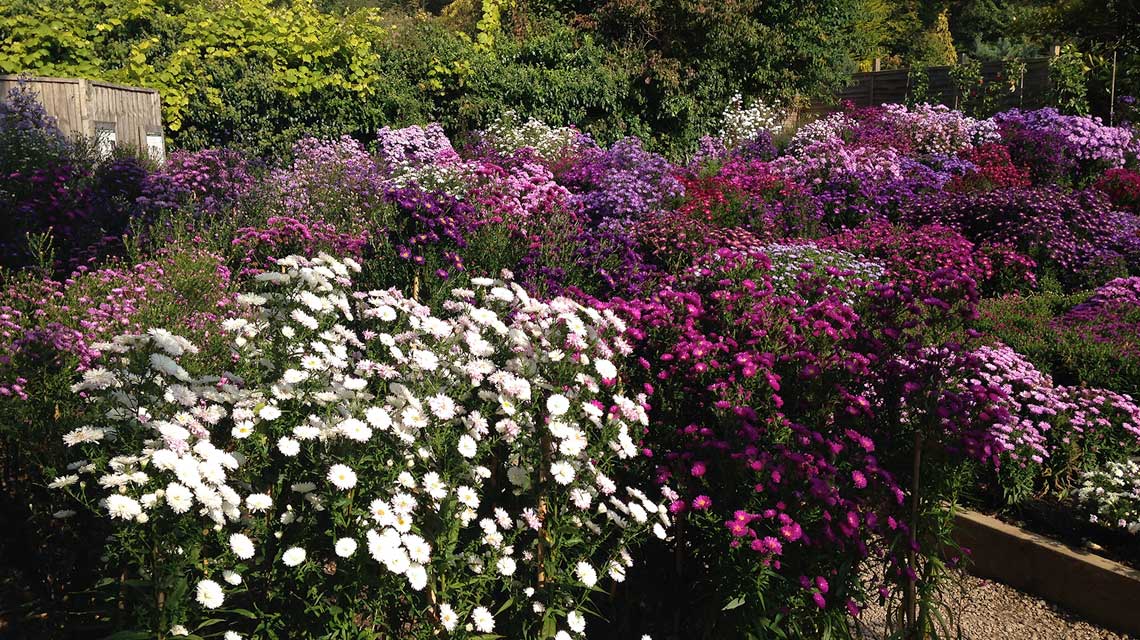
This is a border full of colour that changes over the season. In high summer, Geraniums ‘Brookside’ and ‘Rozanne’ add blue to the border, as does Agapanthus ‘Lapis Lazuli’, Campanula lactiflora ‘Pritchard’s Variety’ together with the spikes of purple-blue Salvia ‘Carradonna’. The yellow daisies of Anthemis ‘E.C.Buxton’ stand tall as do the flower stems of Phlomis russeliana. This great structural plant also adds interest to the garden in winter as its dead stems remain tall and strong even in bad weather.

The silvery filigree foliage of Artemisia ‘Powys Castle’ forms a cooling clump of foliage mid border while the tactile silver leaves of lamb’s ears (Stachys byzantina) runs up to the path, which is edged with the little daisy Erigeron karvinskianus.
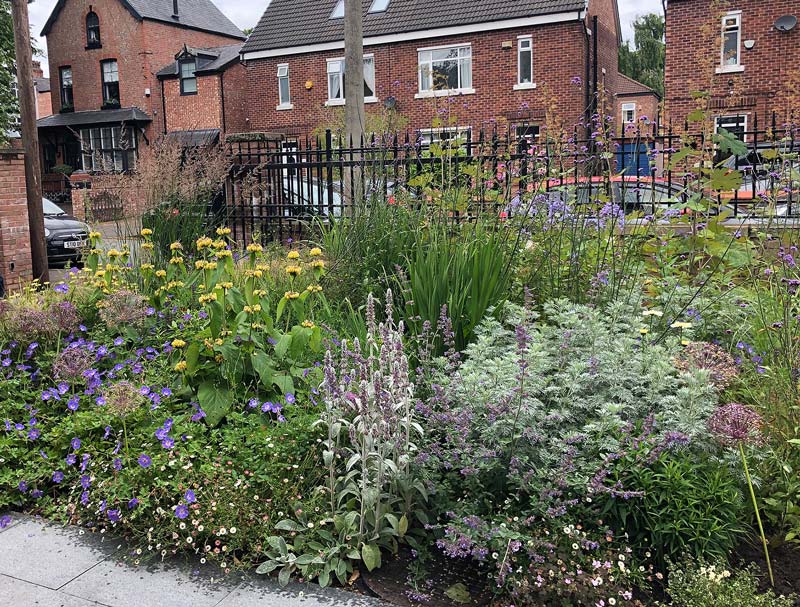
Tall Macleaya x kewensis ‘Flamingo’ forms the back drop to the planting together with a couple of Trachelospermum jasminoides, which have started to twine round the railings. In the corner of the plot, a standard Malus ‘Evereste’ stands tall and replaces a street tree that had to be removed. Here it acts as a focus for the corner and doesn’t shade the other plants.
I’m looking forward to following the development of this garden as it progresses through the seasons. On a recent visit, I noted some of the original wildflowers have seeded and squeezed into the mix. The more the merrier!
On a smaller scale, I planted up a similar border 18 months ago. Here, the client confessed to not being a gardener and was nervous at the suggestion of a mix of grasses and flowers to create a natural looking border.
The only time I have ever used astroturf in a garden was here and it was to create a small practice putting green for the golf-mad client. Sandwiched between the garage and the house, this small area (approx 4m x 2.5m) became the putting green and the strip between the green and the decked seating area became known as ‘the rough’.
Although the ‘rough’ on a golf course is really just slightly longer grass, here I added a stand of the tall, straight grass Calamagrostis ‘Karl Foerster’. I added alliums, Campanula persicifolia, Geum ‘Mrs Bradshaw’, Verbena bonariensis, Scabiosa ochroleucha and a scattering of wild oxeye daisies. It’s more of a meadow than a rough, but it makes me feel better about the astroturf and it’s a joy to see the bees and butterflies that have flown into this garden.
Add flowers and they will appear!